.svg)
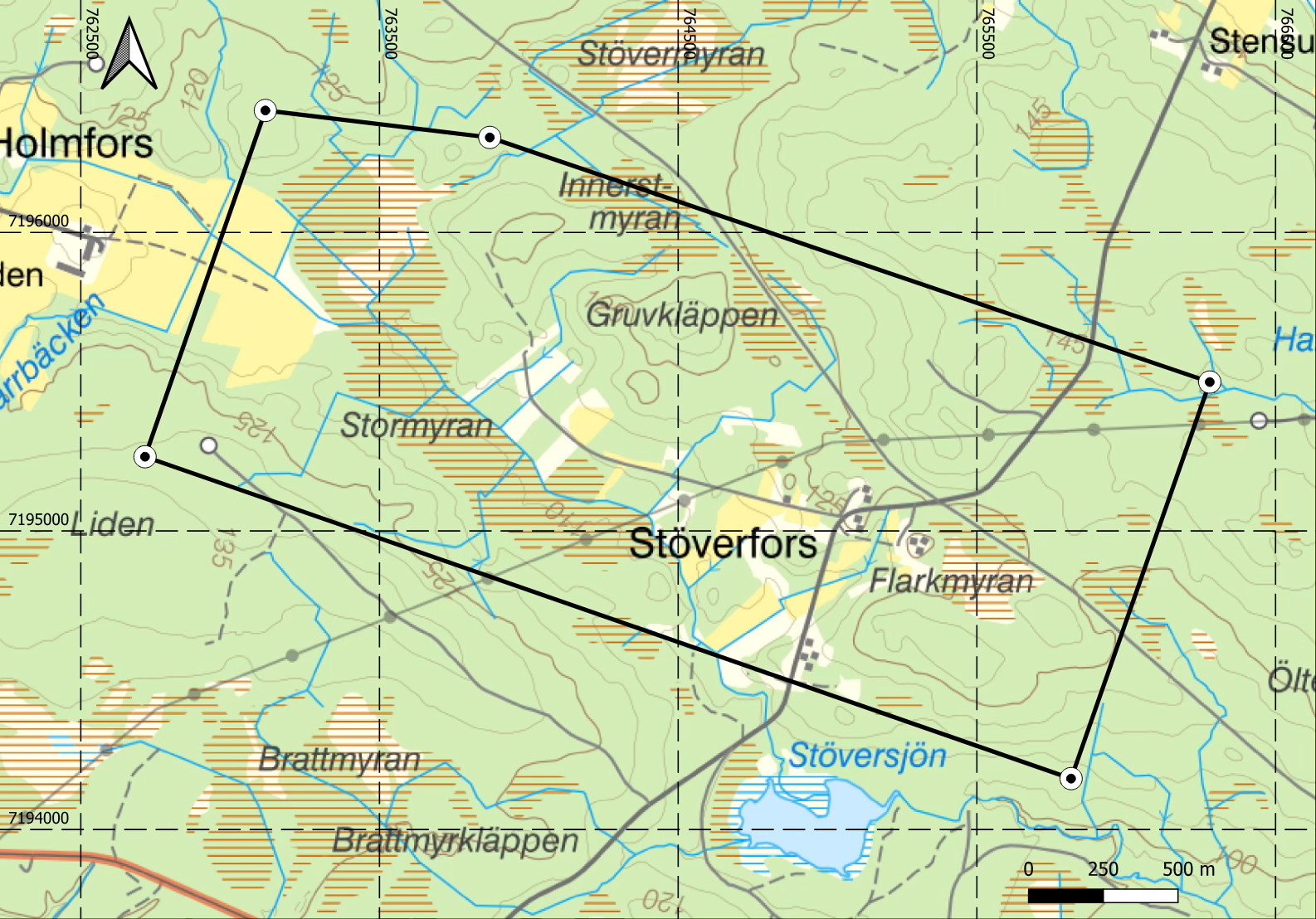
Permit Name: Stöverfors nr 99
Location: Skellefteå municipality, Västerbotten County, Sweden
Permit Area: 451.93 hectares
Target Mineral: Gold, copper and silver

The Stöverfors project is located within Skellefteå municipality, approximately 30 kilometres from the town of Skellefteå. The 452-hectare permit area is accessible via local roads and benefits from the district's well-developed mining infrastructure, which has supported continuous mining operations since the 1920s. The permit area encompasses the village of Stöverfors, Stöversjön lake, and the topographic features of Gruvkläppen, Stormyran, Innerstmyran, and Flarkmyran.
Stöverfors lies within the Skellefteå mining district (Skelleftefältet), one of Europe's most important metallogenic provinces and one of its most prolific gold, copper and silver producing regions. The district is characterized by Paleoproterozoic bimodal volcanic sequences and associated sedimentary rocks that host VMS-type gold, copper and silver polymetallic deposits, the same geological setting Stöverfors sits directly within.
The Skellefteå district has been in continuous production since the 1920s. The original Boliden mine alone produced 128 tonnes of gold, 411 tonnes of silver and 118,000 tonnes of copper from 8.3 million tonnes of ore, a polymetallic signature that has defined the district ever since and continues at Boliden's operations today, where ore is currently processed at grades including approximately 1.5% copper and 78 g/t silver, alongside gold.


SGAB report BRAP 82108 of the Stöverfors area identifies two known bedrock outcrops with mineralised quartz veins, situated within the same gold, copper and silver bearing VMS system that has produced across the district for over a century. Historical hand sample results from these veins have returned gold grades as high as approximately 32 g/t Au, reflecting the broader polymetallic character of the mineralisation.
Arsenopyrite-bearing quartz vein assemblages of this type are well documented across the Fennoscandian Shield within gold-copper-silver polymetallic systems, consistent with the mineralisation styles found throughout the Skellefteå district. Building on these historical indications, Svea Mining completed its inaugural systematic geochemical sampling program at Stöverfors.
The case for exploration at Stöverfors rests on: the property's location within the Skellefteå mining district, one of Europe's most productive gold, copper and silver metallogenic provinces with 100+ years of mining history; two mineralised occurrences registered with the Swedish Geological Survey (SGU), including one classified as a 'significant prospect'; a quartz vein assemblage consistent with gold-copper-silver polymetallic systems found throughout the Fennoscandian Shield, including historical gold grades of up to 32 g/t Au; and very limited modern exploration, suggesting the full extent of mineralisation has not been tested.

Svea Mining completed its inaugural field exploration program at Stöverfors in October 2026. The program included systematic soil sampling, rock chip and grab sampling of all accessible outcrop and mineralised float including the known arsenopyrite-bearing quartz vein occurrences, strict chain of custody sample management, and ongoing geological mapping. All samples have been submitted to an accredited independent analytical laboratory and results are currently pending. Subject to the laboratory results, the Company plans to advance directly to a drill program targeting the strongest anomalies identified by the geochemical and geological data.
Swedish Geological Survey (SGU) mineral and rock occurrence database: ORED05115 and ORED16308. Additional references: SGAB BRAP 82108, SGU C 389, SIND 1979:9, SGAB PRAP 91537, SGAB PRAP 91501.
Cautionary Note: Historical results are based on limited sampling from prior campaigns and have not been independently verified. These results, including historical gold grades, should not be relied upon as indicative of gold, copper or silver mineralisation on the property. Mineral exploration is speculative; there is no assurance that expenditures will lead to economically viable deposits. No drilling or resource estimation has been completed.